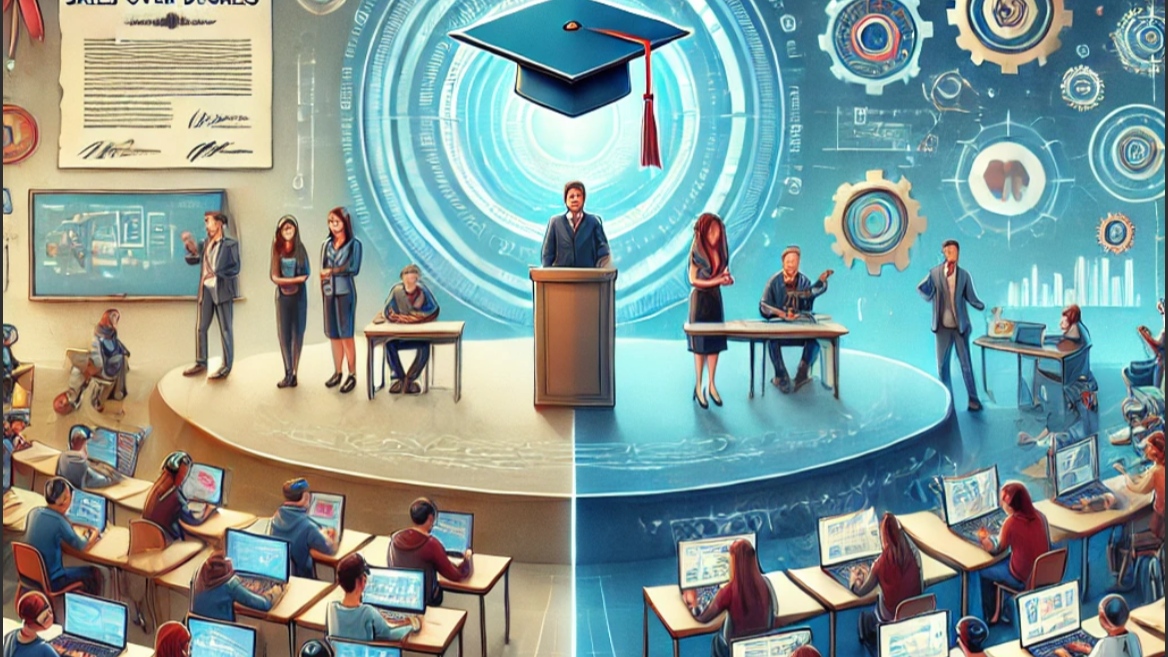
There’s a quiet shift happening in how we think about education. Not loud, not dramatic—but steady enough that you start noticing it in everyday conversations. Someone drops out to build a startup. Another learns coding from YouTube and lands a job. Meanwhile, a fresh graduate with a polished degree is still figuring things out.
It makes you wonder—what’s actually more valuable now? The degree on paper, or the skills you can prove?
The Old Promise of Degrees
For decades, degrees were the safest bet. Go to college, get a qualification, and you’re set—at least, that’s how the story went. It made sense back then. Employers needed a way to filter candidates, and degrees acted like a shortcut for credibility. For additional context, see Why Most Productivity Advice Fails Students (And What Actually Helps).
There’s still value in that structure. Universities don’t just teach subjects—they shape thinking. Discipline, exposure, networking… these things matter more than we admit sometimes.
But here’s the thing: the world has sped up.
What you learn in year one might already feel outdated by the time you graduate. And that gap—between education and industry—is where doubts start creeping in.
The Rise of Skill-Based Learning
Now compare that with skill-based learning. It’s direct, practical, and often… messy. You learn by doing. Trial, error, repeat.
Someone learns graphic design through freelance projects. Another picks up digital marketing by running small campaigns. No formal structure, no fixed curriculum—just real-world application.
And employers? They’re paying attention.
In many industries, especially tech and creative fields, what you can do matters more than where you studied. A strong portfolio can speak louder than a degree certificate ever could.
Skill-based learning vs degree-based education: future me kya demand rahegi
This question doesn’t have a clean, one-size-fits-all answer. But if you look closely at trends, the balance is shifting toward skills—especially those that are adaptable and continuously evolving. A useful related perspective is Do Online Certifications Really Matter Anymore? A Ground-Level Look at Their Value.
The future isn’t just about having knowledge. It’s about applying it. Solving problems. Learning fast, unlearning faster.
Degrees might still open doors, but skills are what keep you inside the room.
Where Degrees Still Hold Ground
It would be unfair—and honestly inaccurate—to say degrees are becoming irrelevant. In fields like medicine, law, engineering, or academia, formal education is non-negotiable.
You can’t become a doctor through online tutorials. And you wouldn’t want to, either.
Degrees also offer something deeper—a structured way of thinking. They train your brain to analyze, question, and understand systems. That foundation can be incredibly valuable, especially in complex fields.
The Hybrid Approach Nobody Talks About Enough
Here’s where things get interesting. The real advantage might lie in combining both approaches.
Imagine someone with a degree who also builds skills on the side. Or someone who starts with skills but later formalizes their knowledge through education.
That combination? It’s powerful.
Because while degrees provide depth, skills offer speed. Together, they create a kind of balance that’s hard to ignore. You may also find Why You Feel Tired All the Time Even When You Sleep Enough helpful.
The Reality of the Job Market
Talk to people hiring today, and you’ll notice a pattern. They’re less interested in theoretical knowledge and more curious about real-world experience.
“What have you built?”
“What problems have you solved?”
“What can you show me?”
These questions come up more often than “Which college did you go to?”
That doesn’t mean degrees don’t matter—it just means they’re no longer enough on their own.
Learning Is Becoming More Personal
Another subtle shift is happening in how we learn. It’s no longer confined to classrooms.
People are building their own learning paths—mixing online courses, internships, freelance work, and self-study. It’s less linear, more flexible.
And honestly, more aligned with how the real world works.
Because outside of exams and grades, learning rarely follows a neat structure. For a closer look at this topic, read Bangalore Moves: Flyover Standoffs, Fickle Skies and a Pressure Cooker With History.
So, What Should You Focus On?
If you’re just starting out, it’s easy to feel stuck between these two paths. Should you chase a degree? Or jump straight into skill-building?
Maybe the better question is—what kind of learner are you?
If you thrive in structured environments, a degree might give you the clarity you need. If you’re more hands-on, experimenting and learning on the go, skills might come naturally to you.
There’s no wrong answer here. Just different journeys.
A Thought Worth Holding On To
The future doesn’t belong to degrees or skills alone. It belongs to people who keep learning—regardless of the format.
Because in a world that changes this fast, what you know today won’t be enough tomorrow.
So maybe it’s not about choosing sides.
Maybe it’s about staying curious, staying adaptable… and building something that’s uniquely yours. Related coverage: Building a Guest Post Strategy That Strengthens Brand Authority.
And whether that starts with a classroom or a YouTube tutorial—well, that part’s up to you.